

The Met Office has warned that the developing El Niño could be the strongest in living memory. This does not mean that Wraysbury will flood. It does mean that the possibility of a wet and stormy autumn and early winter has increased—and that a community with Wraysbury’s history should use the warning time wisely.
El Niño is a natural warming of the tropical Pacific Ocean that can disrupt weather patterns around the world. According to the BBC report published on 21 August, temperatures are already more than 2°C above normal in the key monitoring region, while Met Office forecasts suggest the anomaly could exceed 3°C later this year. Professor Adam Scaife, the Met Office’s head of long-range forecasting, described the signal in its forecasts as unprecedented.[1]
Its effects are strongest around the Pacific. In Britain they are less direct because our weather is also controlled by the Atlantic, the jet stream and other climate influences. Nevertheless, the Met Office says El Niño can increase the likelihood of milder, wetter and windier conditions during autumn and early winter. It may also increase the chance of colder, calmer weather later in winter, although these UK connections are less certain.[2]
This is a warning about increased risk, not a prediction that a particular Wraysbury road or house will flood. But resilience is not about waiting for certainty. It is about recognising a credible threat early enough to reduce its consequences.
What Wraysbury’s history tells us
Wraysbury does not need to imagine what prolonged Thames flooding looks like. The local record includes extensive flooding in 1947, significant flooding in 2003, the prolonged emergency of 2013–14 and the impacts of Storm Henk in January 2024.[3]
The Royal Borough’s investigation of Storm Henk found that Wraysbury Parish experienced the widest flooding impacts in the borough. The Thames broke its banks in several places, roads were closed, groundwater rose beneath and around properties, and some residents reported water remaining in their gardens four months later. The report also describes links between river water, local lakes, groundwater and the Wraysbury Drain.[4]
The winter of 2013–14 shows why persistence matters. During the 66 days to 16 February, the Thames catchment received 409mm of rain—equivalent to 56% of annual rainfall. The slow-reacting lower Thames did not reach its peak flow until mid-February, when 507 cubic metres per second was recorded at Kingston.[5]
A flood emergency therefore does not necessarily begin with one extraordinary downpour over Wraysbury. It can develop through repeated rainfall across the enormous upstream catchment. As soils become saturated, more water reaches streams and rivers; groundwater rises; drains and sewers come under pressure; and access routes may be lost before water enters a home.
Wraysbury also faces several interacting sources of flooding: the Thames, surface water, groundwater, smaller watercourses, drains and sewers, and water moving through permeable river gravels. Conditions can combine in ways that are difficult to forecast precisely.
Does the drought reduce or increase the danger?
The answer is: it may reduce some risks initially while increasing others.
July 2026 was the driest July in the Thames area since records began in 1871. Only 1mm of rain was recorded—around 1% of the long-term average. Soil moisture deficits were exceptionally high, and River Thames flows at Windsor and Kingston were classified as exceptionally low.[6]
That creates some initial headroom. If rain returns gradually, a proportion will replace the soil-moisture deficit and recharge groundwater before prolonged river flooding becomes likely.
However, it is not accurate to think of every aquifer as an empty underground reservoir. At the end of July, monitored groundwater levels across the Thames area ranged from notably low to notably high. Chalk and Lower Greensand aquifers had remained relatively resilient because of water stored following the previous wet winter.[6]
Nor does drought remove the risk of flash flooding. The Environment Agency has specifically warned that flooding can occur during drought because dry soils may struggle to absorb intense downpours quickly enough.[7] If rain falls faster than the soil, drains and watercourses can accommodate it, water runs across the surface and collects on roads, paved areas and other low points.
The sequence of risks could therefore be:
- Following an intense downpour: localised surface-water flooding, overloaded drains and hazardous roads.
- Following repeated rainfall: soils become wetter and an increasing proportion of rainfall reaches watercourses and the Thames.
- Following prolonged catchment-wide rainfall: river levels and shallow groundwater rise, progressively removing the storage advantage created by the drought.
This distinction is particularly important in Wraysbury. The borough’s investigation describes river water moving through permeable gravels as the Thames rises and groundwater being influenced by local lakes and drainage constraints.[4] General figures for deeper regional aquifers are therefore not a complete guide to Wraysbury’s local, shallow groundwater risk.
The drought may delay a prolonged river or groundwater event, but it does not protect the village from an intense downpour. Sustained autumn or winter rain can gradually erase the deficit.
What can reasonably be extrapolated?
It would be wrong to claim that a powerful El Niño must produce a repeat of 1947, 2014 or 2024. No two El Niño events are identical, and a record Pacific temperature does not automatically translate into record rainfall over Berkshire.
A responsible conclusion is that, if El Niño helps establish a succession of Atlantic weather systems, Wraysbury already has the geography and historical vulnerability that can turn persistent rainfall into a serious emergency.
There is also a long-term change in the background risk. The Government’s River Thames Scheme page states that by 2050 average UK winter rainfall could increase by approximately 41% and peak river flows by approximately 50%.[3] These are climate projections, not a forecast for this winter, but they show why past floods should be treated as planning benchmarks rather than the maximum that could happen.
Use Wraysbury’s local flood resources
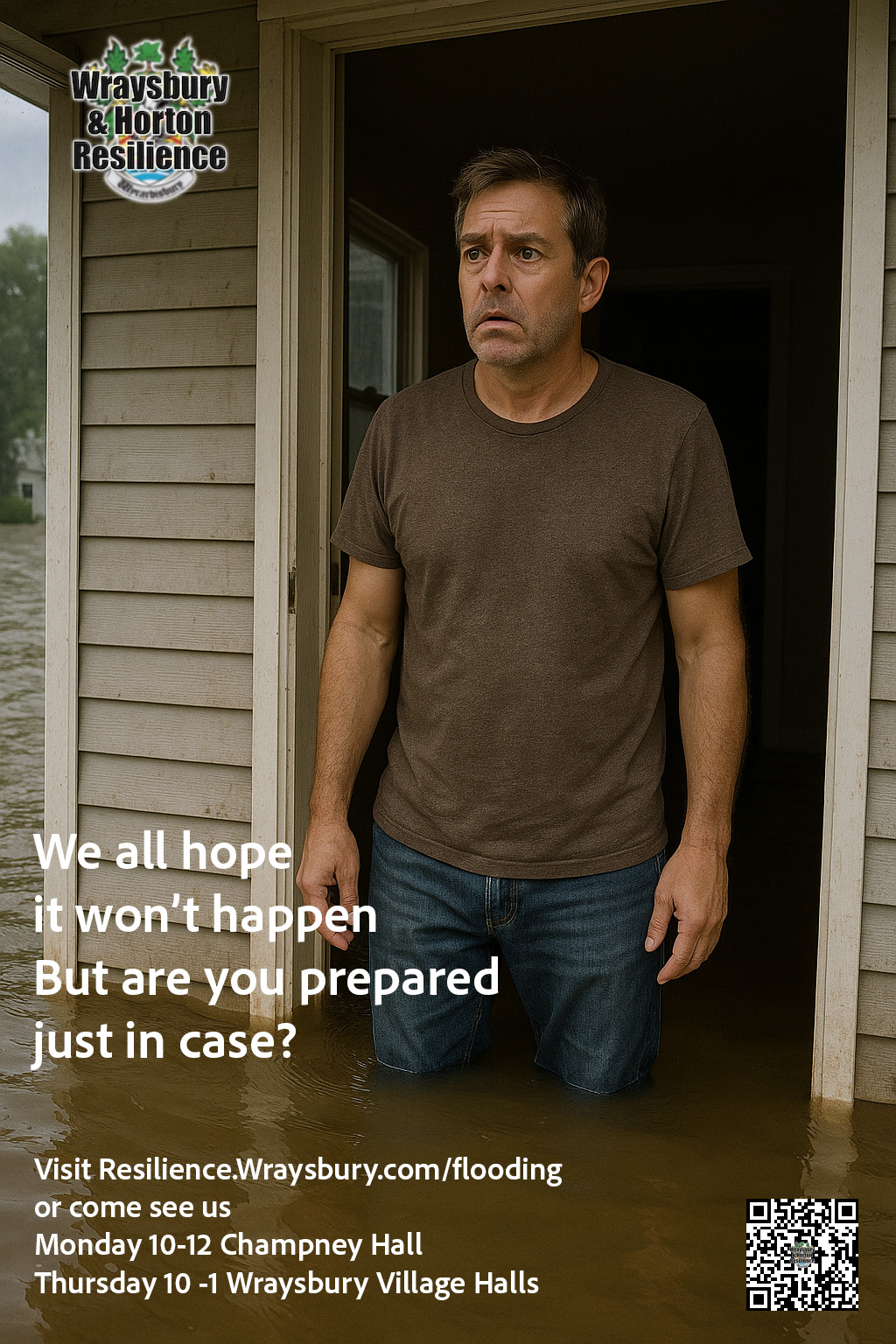
Residents should now visit the Wraysbury & Horton Resilience Flooding page. It provides local guidance on warning stages, household flood plans, property protection, vehicle arrangements, emergency contacts and recovery.
The Wraysbury & Horton Flood Teams monitor Environment Agency information, river levels, weather forecasts and local conditions. During periods of increased risk, Wraysbury & Horton Resilience may issue local Risk Updates. These add local context but do not replace Environment Agency warnings or instructions from the emergency services.[8]
The Flood Teams and other volunteers cannot protect every property once an emergency has begun. During a significant flood, their limited resources must be prioritised towards the most vulnerable residents. Every household should therefore prepare in advance.
What residents should do now
Every household should:
- Register for free Environment Agency flood warnings and understand the difference between a Flood Alert, Flood Warning and Severe Flood Warning.
- Remember that Environment Agency warnings do not cover surface-water flash flooding. Monitor Met Office warnings, WHR Risk Updates and local conditions as well.[9]
- Make a written flood plan covering family members, pets, vehicles, medicines, valuables, evacuation routes and somewhere safe to go.
- Assemble a flood kit or grab bag containing medication, essential documents, chargers and a power bank, a torch, first-aid supplies, water, snacks, waterproof clothing, spare keys and any baby, disability or pet supplies.
- Check insurance, photograph possessions and protect important documents and sentimental items in waterproof containers above the likely flood level.
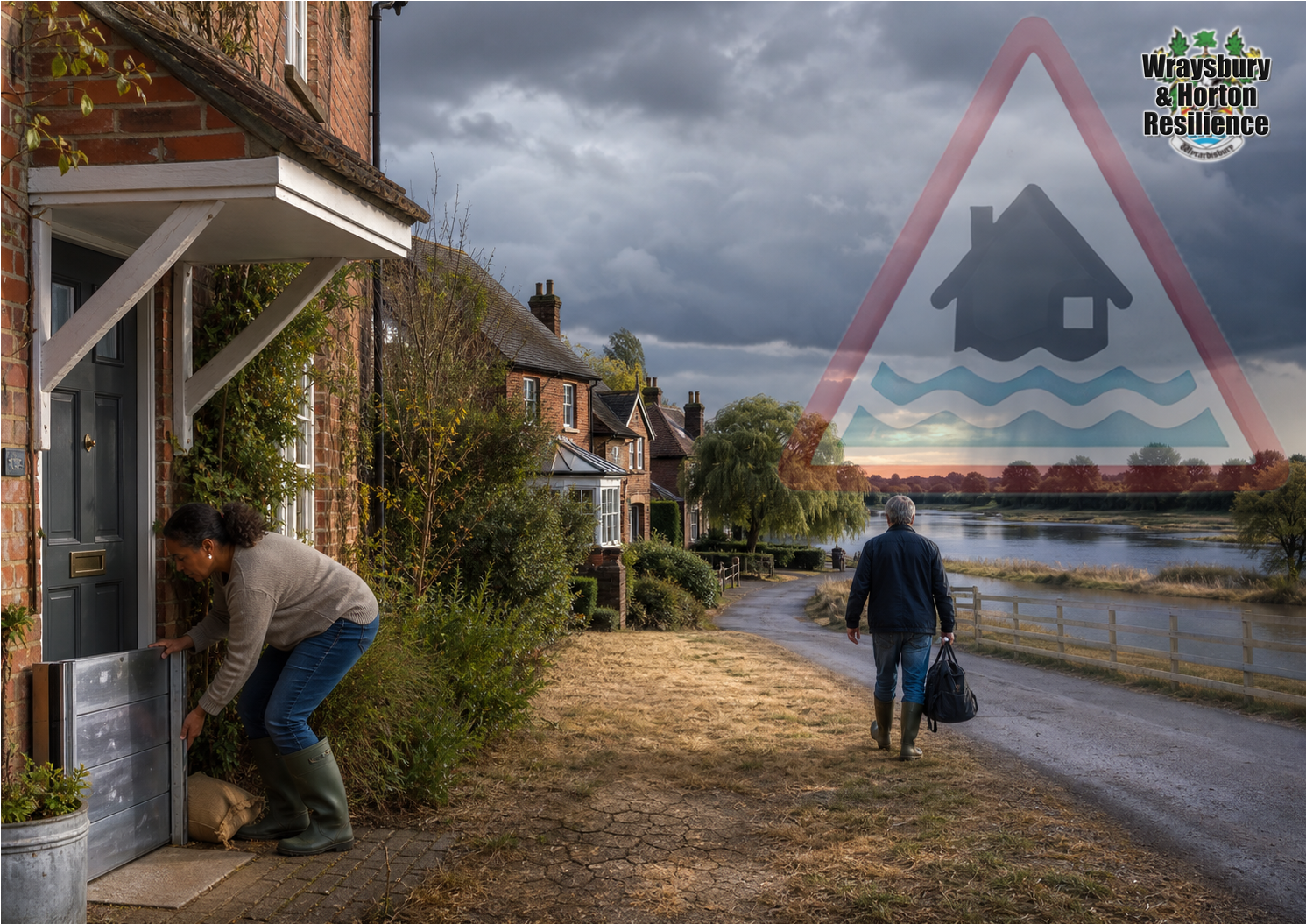
- Inspect and practise fitting flood doors, barriers and airbrick covers. Check pumps, batteries and other property flood-resilience equipment before it is needed.
- Check drains and gullies on your own property and report blocked public drains or watercourses to the responsible authority.
- Decide early where vehicles can be moved without obstructing residents or emergency vehicles. Do not wait until surrounding roads are already flooded.
- Never walk or drive through floodwater.
Help us identify residents who may need support
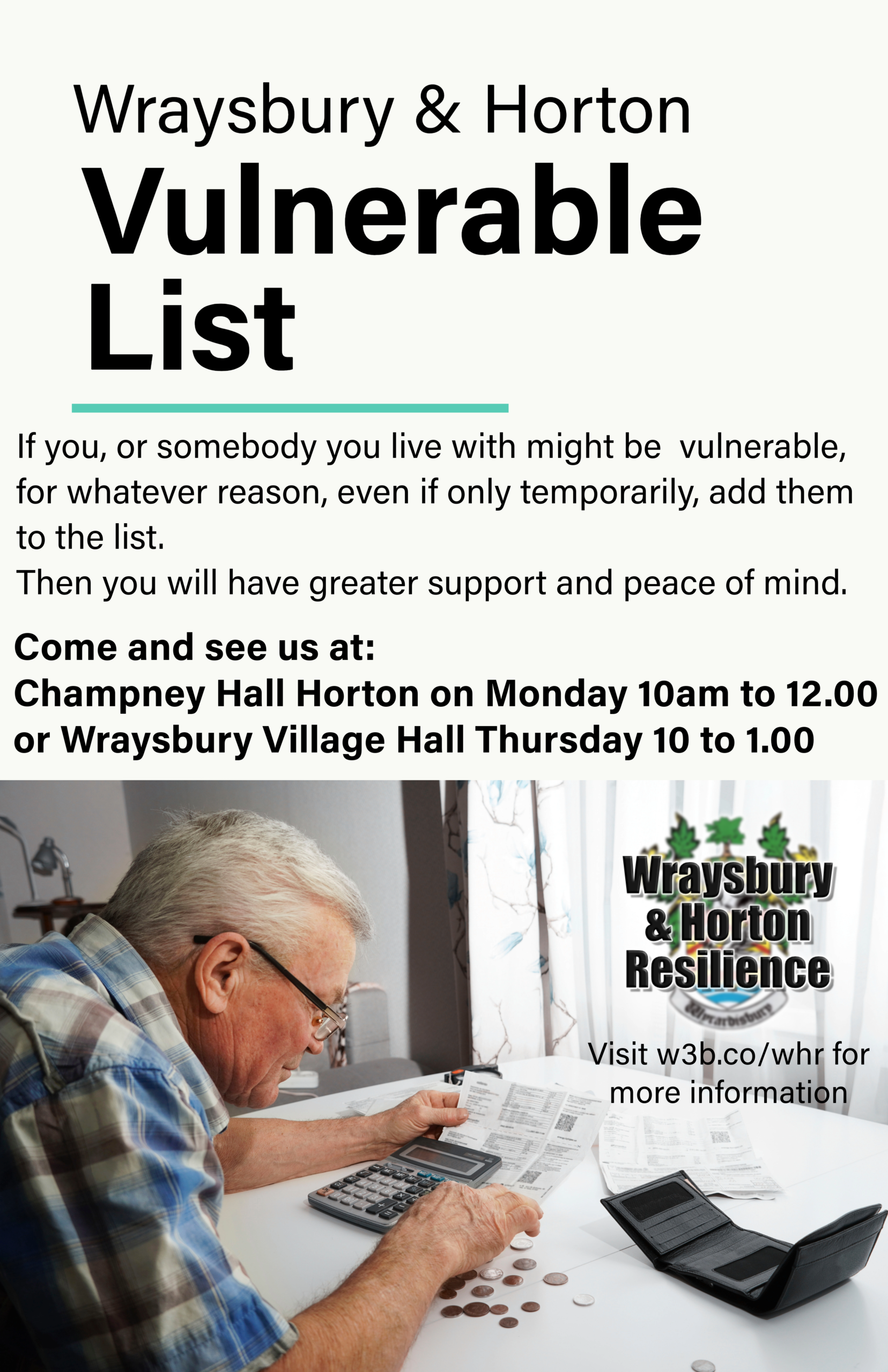
If an emergency could leave you or somebody you know unable to manage safely without additional help, ask to join the WHR Vulnerable Register.
There are no specific qualifying conditions and there is no charge. Residents may ask to be added themselves or request inclusion for their next of kin. The information is held securely and may be shared with statutory authorities where WHR believes there is a substantial risk to an individual.[10]
To contact Wraysbury & Horton Resilience, telephone 07808 654321 or visit one of its local public sessions.
Prepare for the possibility—not the prediction
Wraysbury should neither panic nor dismiss the warning. El Niño may have little direct local effect. Equally, intense rainfall could produce surface-water problems while the wider area remains in drought, or repeated storms could gradually recreate the saturated-ground and high-river conditions responsible for previous floods.
The village has been given something valuable: advance notice that the coming seasons may carry an elevated and unusual level of uncertainty.
Sign up for warnings. Read the local flood guidance. Write the plan. Check the equipment. Join the Vulnerable Register if support may be needed. Talk to neighbours.
Do these things before prolonged rain begins, because once water is rising, time becomes the resource that is hardest to recover.
References
- BBC Weather, “El Niño set to be ‘strongest in living memory’, says Met Office”, 21 August 2026.
- Met Office, “El Niño declared for 2026 as Pacific warms”, 11 June 2026.
- Environment Agency and partners, River Thames Scheme: history and climate projections.
- Royal Borough of Windsor and Maidenhead, Storm Henk January 2024: Section 19 Flood Investigation Report, especially the Wraysbury section, pages 57–65.
- Environment Agency, “The calm after the storms”, 14 April 2014.
- Environment Agency, Thames water situation: July 2026 summary, updated 12 August 2026.
- Environment Agency and Defra, drought and flash-flood risk following intense rain, 14 November 2025.
- Wraysbury & Horton Resilience, Flooding: local preparation and response guidance.
- Environment Agency, free flood-warning service and its limitations.
- Wraysbury & Horton Resilience, WHR Vulnerable Register.