Author: Site Admin

  • Heat health alert updated for the South East

    Heat health alert updated for the South East

    The amber heat health alert is in effect from9AM on 03/08/2026 until 9AM on 05/08/2026 across the South East. The amber alert has a matrix score of 12. This means:

    Significant impacts are likely across health and social care services due to the high temperatures, including:

    • a rise in deaths, particularly among those aged 65 and over or with health conditions. There may also be impacts on younger age groups
    • likely increased demand on all health and social care services
    • internal temperatures in care settings (hospitals and care homes) may exceed the recommended threshold for clinical risk assessment
    • the heat affecting the ability of the workforce to deliver services
    • indoor environments overheating increasing the risk to vulnerable people living independently in community and care settings
    • issues managing medicines
    • staffing issues due to external factors (for example, affecting transport)
    • increased demand for power exceeding capacity
    • other sector starting to observe impacts (for example, travel delays)
    • water-related incidents may increase, including risks from cold-water shock and drowning

    For more information on coping with extreme summer heat, click Here

  • Heat-Related Deaths: A Stark Warning

    Heat-Related Deaths: A Stark Warning

    Heat-Related Deaths: A Stark Warning

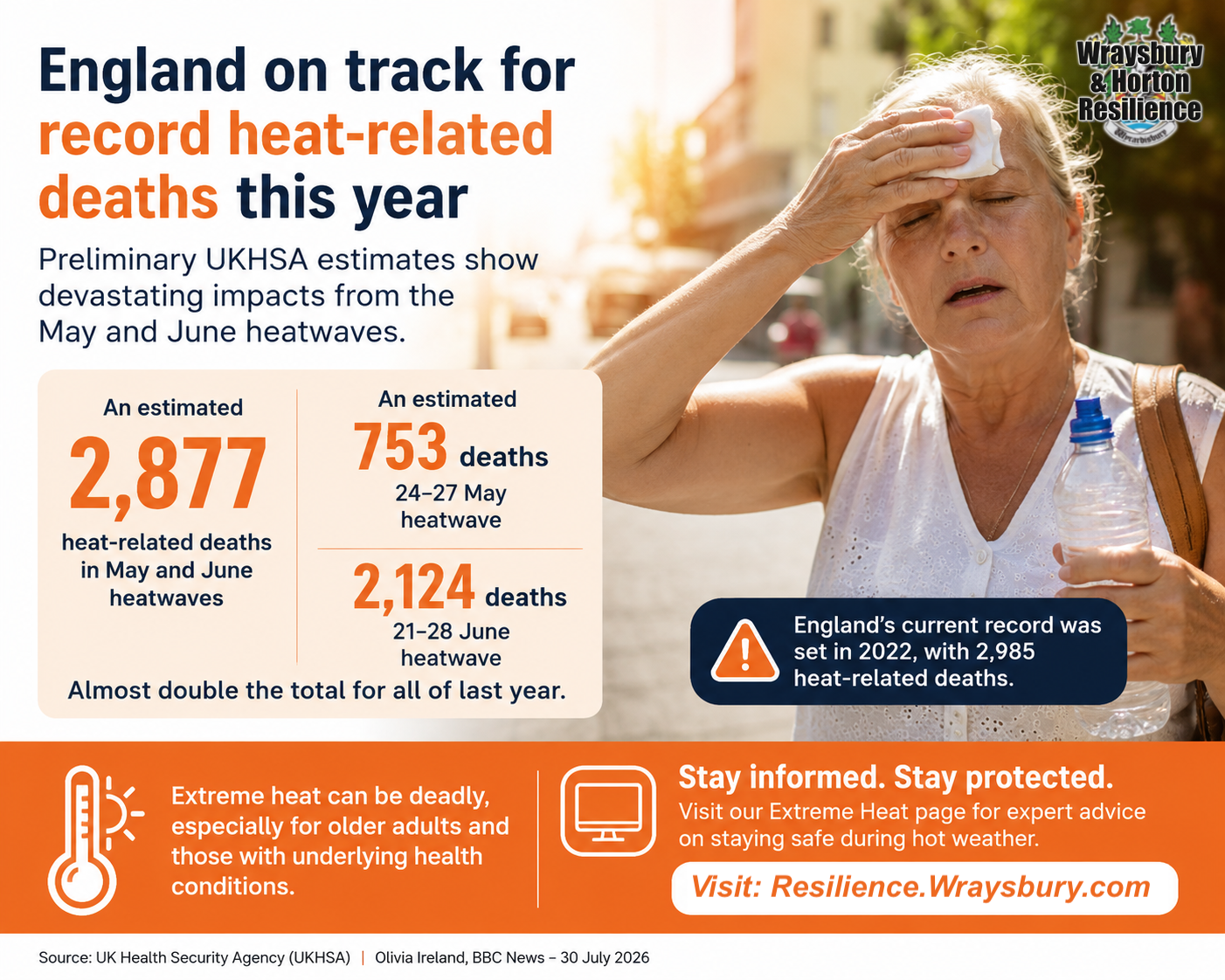
    Graphic showing number of Excess Deaths as 2877 this year so far, with lady mopping her brow in the heat.

    The latest figures from the UK Health Security Agency (UKHSA) paint a worrying picture. An estimated 2,877 people died during the May and June heatwaves in England – almost double the total for the whole of last year. If further periods of extreme heat occur this summer, 2026 could become the worst year on record for heat-related deaths.

    Although temperatures have eased for now, it’s still only the end of July. August and even early September can still bring prolonged periods of very hot weather, so this is not the time to become complacent.

    Extreme heat is often called the β€œsilent weather emergency” because its effects are not always obvious. Older people, those with heart, lung or kidney conditions, people taking certain medicines, young children and anyone who becomes dehydrated can all be at increased risk.

    Now is a good time to:

    • πŸ’§ Review your personal hot weather plan.
    • 🏠 Check that your home can be kept as cool as possible.
    • πŸ‘΅ Contact an older relative, friend or neighbour during hot spells.
    • 🌑️ Know the signs of heat exhaustion and heatstroke.

    Our Extreme Summer Weather page explains how to prepare, stay safe during hot weather, recognise when someone is becoming unwell, and where to get further help.

    πŸ”— Visit: Extreme Summer Weather

    Source: UK Health Security Agency (UKHSA) estimates reported by Olivia Ireland, BBC News (30 July 2026).

  • Alert Status Update

    Alert Status Update

    There are currently no health alerts or other expected risks to our community.

    Whilst we have identified no community-wide risks, we advise residents to remain vigilant and mindful to protect themselves, their neighbours and our wider community. We should be aware of risks to individual households, such as scams, cybercrime and theft. Always stay aware, and use this opportunity to prepare ourselves for any potential problems.

    Use the guidance on our website to protect yourselves.

  • Medicines and Hot Weather

    Some medicines can make it harder for your body to cope with very hot weather.

    This does not mean that your medicine is unsafe or that you should stop taking it. For most people, no change to their medication will be necessary.

    However, if you take one or more of the medicines below, it is worth being particularly careful about keeping cool and avoiding dehydration during very hot weather.

    Medicines that may need extra care in hot weather

    πŸ’§ Water tablets (diuretics)

    Examples include furosemide and bumetanide.

    These increase the amount of water and salts lost through urine. During hot weather this can increase the risk of dehydration, low blood pressure and changes in body salts.

    ❀️ Medicines for blood pressure or heart conditions

    These include:

    ACE inhibitors β€“ such as ramipril and lisinopril
    ARBs β€“ such as candesartan and valsartan
    Beta-blockers β€“ such as bisoprolol, atenolol and metoprolol
    Calcium-channel blockers β€“ such as amlodipine and lercanidipine

    Hot weather naturally lowers blood pressure and increases fluid loss. Some of these medicines can therefore increase the likelihood of dizziness, fainting or falls, particularly if you become dehydrated.

    🧠 Antidepressants and medicines for mental health

    These include some:

    Antidepressants β€“ including SSRIs, SNRIs and tricyclic antidepressants
    Antipsychotics β€“ such as quetiapine and risperidone
    Sedatives and medicines that cause drowsiness

    Some can affect sweating, thirst, alertness or the body’s ability to control its temperature.

    🚻 Medicines with an anticholinergic effect

    These include some medicines used for bladder problems, such as solifenacin and tolterodine, as well as a number of medicines used for other conditions.

    They can reduce sweating, making it more difficult for the body to cool itself.

    🧠 Medicines for epilepsy

    Some anti-seizure medicines, including topiramate, carbamazepine and oxcarbazepine, can affect sweating, fluid balance or how the body responds to heat.

    πŸ’Š Lithium, digoxin and some other closely monitored medicines

    Dehydration can change the amount of some medicines in your bloodstream and increase the possibility of side effects or toxicity.

    Lithium is particularly important: if you take lithium, take extra care to avoid dehydration and follow the advice you have been given about fluid intake.

    πŸ’‰ Diabetes medicines

    Hot weather and dehydration can affect people with diabetes, and heat can also affect insulin, blood glucose monitors and test strips.

    Insulin may be absorbed more quickly in hot weather, potentially increasing the risk of low blood sugar.

    πŸ’Š Anti-inflammatory painkillers (NSAIDs)

    Examples include ibuprofen, naproxen and diclofenac.

    If you become significantly dehydrated, these medicines can increase the risk of kidney problems.

    β˜€οΈ Medicines that can make your skin more sensitive to sunlight

    Some medicines can make you burn more easily or cause a skin reaction in strong sunlight. Examples include some antibiotics such as doxycycline and ciprofloxacin, some antifungal medicines and methotrexate.

    Check the information supplied with your medicine and take particular care with shade, protective clothing and sunscreen.


    What should I do?

    Keep taking your medicines as prescribed. Do not stop, reduce or alter a medicine because the weather is hot unless a healthcare professional has advised you to do so.

    During very hot weather:

    • keep yourself as cool as possible
    • drink regularly, unless you have been specifically advised to restrict your fluid intake
    • avoid becoming dehydrated
    • get up slowly if you are prone to dizziness
    • protect yourself from strong sunlight
    • keep medicines cool, dry and away from direct sunlight, following the storage instructions on the packaging.

    Not sure about one of your medicines?

    Ask your local pharmacist.

    Pharmacists are medicines specialists and can check your individual medicines and tell you whether you need to take any additional precautions during hot weather.

    You do not normally need an appointment with your GP or hospital specialist simply because your medicine appears on this list.

    If your pharmacist believes that your medication needs reviewing, they can advise you about the appropriate next step.

    When to seek medical help

    If you become unusually dizzy, faint, confused, very weak, develop significantly reduced urine output, or are concerned that you may be dehydrated or suffering from heat-related illness, seek medical advice.

    Heatstroke is a medical emergency. If someone is very hot and becomes confused, has a seizure, loses consciousness or is otherwise seriously unwell, call 999.


    This is general information to help you stay safe during hot weather. It is not a complete list of medicines that may be affected by heat, and individual circumstances vary. Never stop or change prescribed medication without appropriate professional advice.

  • Heat health alert issued for the South East

    Heat health alert issued for the South East

    The yellow heat health alert is in effect from 9AM on 28/07/2026 until 9AM on 31/07/2026 across the South East. The yellow alert has a matrix score of 10. This means:

    Significant impacts are possible across health and social care services due to the high temperatures, including:

    • a rise in deaths, particularly among those aged 65 and over or with health conditions. There may also be impacts on younger age groups
    • a likely increase in demand for health services
    • internal temperatures in care settings (hospitals and care homes) may exceed the recommended threshold for clinical risk assessment
    • the heat affecting the ability of the workforce to deliver services
    • indoor environments overheating increasing the risk to vulnerable people living independently in community and care settings
    • water-related incidents may increase, including risks from cold-water shock and drowning

    For more help with coping with hot weather see our page here

  • Alert Status Update

    Alert Status Update

    There are currently no alerts or other expected risks to our community.

    Whilst we have identified no community-wide risks, we advise residents to remain vigilant and mindful to protect themselves, their neighbours and our wider community. We should be aware of risks to individual households, such as scams, cybercrime and theft. Always stay aware, and use this opportunity to prepare ourselves for any potential problems.

    Use the guidance on our website to protect yourselves.

  • Heat health alert issued for the South East

    Heat health alert issued for the South East

    The yellow heat health alert is in effect from9AM on 24/07/2026 until 9AM on 26/07/2026 across the South East. The yellow alert has a matrix score of 8. This means:

    Minor impacts are expected across health and social care services, including:

    • increased use of healthcare services by vulnerable people
    • greater risk to life of vulnerable people
    • increased potential for indoor environments to become very warm
    • water-related incidents may increase, including risks from cold-water shock and drowning

    For more information on coping with heat visit our page here

  • Alert Status Update

    Alert Status Update

    There are currently no flood alerts or other expected risks to our community.

    Whilst we have identified no community-wide risks, we advise residents to remain vigilant and mindful to protect themselves, their neighbours and our wider community. We should be aware of risks to individual households, such as scams, cybercrime and theft. Always stay aware, and use this opportunity to prepare ourselves for any potential problems.

    Use the guidance on our website to protect yourselves.

  • Heat health alert updated for the South East

    Heat health alert updated for the South East

    The yellow heat health alert is in effect from 9AM on 12/07/2026 until 9PM on 17/07/2026 across the South East. The amber alert has a matrix score of 10. This means:

    Significant impacts are possible across health and social care services due to the high temperatures, including:

    • a rise in deaths, particularly among those aged 65 and over or with health conditions. There may also be impacts on younger age groups
    • a likely increase in demand for health services
    • internal temperatures in care settings (hospitals and care homes) may exceed the recommended threshold for clinical risk assessment
    • the heat affecting the ability of the workforce to deliver services
    • indoor environments overheating increasing the risk to vulnerable people living independently in community and care settings
    • water-related incidents may increase, including risks from cold-water shock and drowning

    To see more help and information for heat risk click here

  • Risk Update: 15/06/2026

    Risk Update: 15/06/2026

    Heat health alert for the South East

    The yellow heat health alert is in effect from3PM on 17/06/2026 until 8PM on 22/06/2026 across the South East. The yellow alert has a matrix score of 7. This means:

    Minor impacts are likely across health and social care services, including:

    • increased use of healthcare services by vulnerable people
    • greater risk to life of vulnerable people
    • increased potential for indoor environments to become very warm
    • water-related incidents may increase, including risks from cold-water shock and drowning

    To see our page on protecting yourself from the risks of Extreme Summer Heat click here